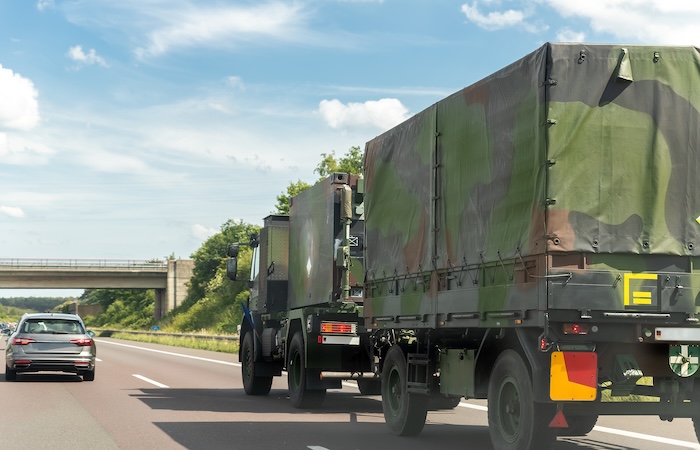
Norwegian route constraints are reshaping fleet planning in 2026. During Cold Response 2026, the Norwegian Armed Forces warned drivers to expect delays in the Narvik area and across Nordland and Troms. Military police temporarily stopped civilian traffic for convoy passage. Allied forces moved equipment from pre-positioned storage to the port of Narvik, then forward through Sweden into Finland.
The exercise ended March 19. But Norway has designated 2026 as Total Defence Year, which means civilian infrastructure is now formally part of military planning. For fleet operators running freight through Norway, military priority on key corridors is a scheduling factor for the rest of the year.
Two Sources of Norwegian Route Constraints
The route variability hitting Norwegian corridors in 2026 comes from two sources, and they compound each other.
1. Persistent military activity
Cold Response ended March 19, but NATO’s Arctic Sentry initiative runs year-round. It’s not a single exercise. It’s a continuous posture across the High North, led by Joint Force Command Norfolk. Allied logistics activity in Nordland, Troms, and Finnmark is now elevated as a baseline. More convoys, more staging, more priority routing requests, even between the headline exercises.
And the headline exercises aren’t over. DEFENDER-Europe 26, AURORA 26, and BALTOPS 26 are all confirmed for spring and summer. Swedish and Finnish corridors will see significant Reception, Staging, and Onward Movement (RSOM) activity.
2. Major construction on E16
Project Arna-Stanghelle is Norway’s largest tunnel initiative: €3.6 billion, 80 km of combined road and rail tunnels on the Bergen-Oslo corridor. Construction runs through at least 2033. Column driving and temporary closures have already affected the E16 since late 2025.
If you’re running Oslo-Bergen freight, this is your primary artery. Alternative routes (E134 via Haukelifjell or RV7 via Hardangervidda) add distance and have different winter viability profiles.
The compounding effect: Military exercises create temporary delays in the north. Construction creates sustained delays in the west. For fleets operating across Norway, schedule buffers need recalibrating on multiple corridors.
What to Do About It
Add buffer to affected routes. Historical journey times on E6 through Nordland, E16 Bergen-Oslo, and E10 Luleå-Narvik are no longer reliable baselines. Build in explicit contingency time. The cost of a late delivery is almost always lower than the cost of a compliance infringement.
Know your alternatives. For Bergen-Oslo freight, map when E134 or RV7 become operationally necessary. For northern routes, identify secondary roads that bypass likely military staging points. Don’t wait until your driver is stuck behind a convoy to figure this out.
Track the exercise calendar. DEFENDER-Europe 26 dates are expected in May. When they’re confirmed, build them into your scheduling.
Document delays when they happen. If a military convoy or construction closure causes a delay that affects driver hours, record it as a manual tachograph entry. Under the 28-day cross-border enforcement rule, any infringement in your trailing 28 days can be penalised in any EU/EEA state. Documentation doesn’t guarantee you avoid a fine, but it provides context for appeals and demonstrates good-faith compliance effort.
Total Defence Year isn’t a single disruption. It’s an operating environment that runs through December. The fleets that plan for it will absorb the variability. Those that don’t risk discovering it during an inspection, at €4,000+ per lesson.
