Denmark’s kilometre-based truck toll is no longer a future problem. It is an operational fact. Since January 2025, trucks over 12 tonnes pay per kilometre on Danish roads, with rates tied to CO₂ emissions and a 50% surcharge for driving through environmental zones in Copenhagen, Aarhus, Odense, and Aalborg.
Since implementation, fines have exceeded DKK 240 million. As of July 2025, the fine was increased to DKK 9,000 per vehicle per day. And for fleets making technical or administrative errors, the penalty is the same as for deliberate non-compliance. According to a recent evaluation reported by trans.info, the current penalty model does not sufficiently distinguish between deliberate non-compliance and unintentional errors, such as technical faults or administrative mistakes.
From 1 January 2027, trucks weighing 3.5 tonnes or more will also be included. That expansion brings service vehicles, delivery vans, and light commercial fleets into the same system that has already generated hundreds of millions in fines from heavier vehicles. From 2028, the toll network is expected to expand to the full public road network of approximately 75,000 km, according to the official Danish toll authority.
For Nordic transport and logistics companies, the question is no longer whether distance-based tolling will affect operations. It is whether the current level of trip documentation is good enough to avoid the fines.
Europe has already moved
Denmark is not alone. The shift from flat-rate vignettes to distance-based, emissions-weighted tolling has become the European standard, and most of the 2026 changes are already in effect.
In Poland, tariffs in the e-TOLL system increased by 40 to 42 per cent in February 2026, while the tolled road network expanded by approximately 645 kilometres. Fleets running transit routes through Poland are already paying the higher rates.
Czechia adjusted its toll tariff from 1 January 2026, with higher CO₂ surcharges and an expanded network of toll-liable road sections. Motorway toll increases were modest, but first-class roads saw sharper rises.
The next major change comes in July: the Netherlands will replace the Eurovignette with a kilometre-based truck toll linked to vehicle weight and CO₂ emissions. The average rate will be 19.1 euro cents per kilometre. The system will apply to vehicles with a gross weight above 3.5 tonnes, regardless of country of registration.
For fleets running cross-border routes through Scandinavia and into continental Europe, the combined effect is significant. Every country has moved or is moving toward per-kilometre charging. Every system has added emissions weighting. And every enforcement regime is getting stricter.
The operational problem is data, not regulation
Higher tolls are manageable when you know what your vehicles are doing. The problem is that most fleets do not have that level of detail.
A driver takes a longer route than planned. A vehicle enters an environmental zone without authorisation. A toll payment fails due to a technical error, and the fine arrives weeks later. These are not edge cases. They are daily realities for fleets operating across multiple toll systems.
In a flat-rate vignette environment, these gaps were invisible. In a distance-based system, they become direct costs. A 30 km detour that used to be unnoticed now shows up on an invoice. A vehicle registered in the wrong CO₂ class pays the wrong rate on every kilometre. An undocumented trip through Copenhagen adds 50% to the toll and, if unpaid, a DKK 9,000 fine.
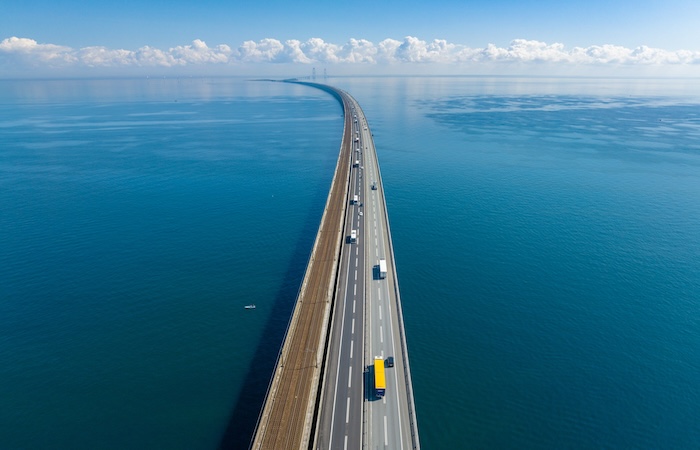
Since July 2025, Danish authorities can stop trucks before the Storebælt Bridge. Drivers are required to either pay the outstanding amount immediately or turn back. That enforcement model is likely to spread as other countries see the results.
What this means for fleet operations
The shift to distance-based tolling rewards precision and punishes guesswork. Fleets with accurate, automated trip records can answer the questions that matter: Which routes cost the most? Are drivers consistently choosing efficient paths? Are vehicles classified correctly in every system they pass through?
Fleets without that data will keep discovering the answers on their invoices, or worse, when a vehicle is stopped at a bridge.
The companies adapting fastest are not necessarily the ones with the newest trucks or the largest budgets. They are the ones that know, kilometre by kilometre, what their fleet is actually doing on the road. When every kilometre has a price, and every error has a fine, that knowledge is the difference between a profitable operation and one that bleeds margin before the month is over.
The January 2027 expansion to 3.5+ tonne vehicles is one of several regulatory deadlines Nordic fleet managers need to track this year. For a complete overview, see our 2026-2027 Fleet Compliance Calendar.
